
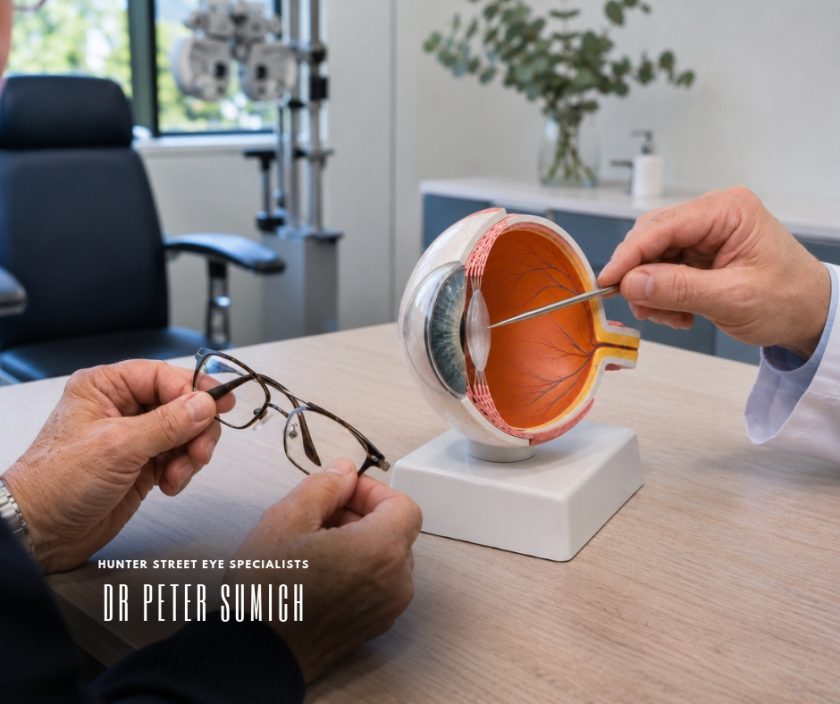
Refractive Lens Exchange in Your 40s and 50s: What to Consider
Around the age of 40, many people begin noticing that reading small print is becoming more difficult. They may hold their phone further away, need brighter lighting or find themselves reaching for reading glasses.
This is usually due to presbyopia, the gradual loss of the natural lens’s ability to change focus between distant and near objects.
For some patients, refractive lens exchange may be one option for managing their vision. But age alone does not determine whether lens replacement surgery is appropriate.
What is refractive lens exchange?
Refractive lens exchange (RLE), also called clear lens extraction, involves removing the eye’s natural lens and replacing it with an artificial intraocular lens (IOL).
The operation uses a surgical approach similar to cataract surgery. The difference is the reason for treatment.
In cataract surgery, the natural lens is removed because it has become cloudy and is affecting vision. In refractive lens exchange, the natural lens may still be relatively clear, but surgery is considered to address refractive error or presbyopia.
Because the natural lens is permanently removed, the decision requires careful consideration of the potential benefits, alternatives and surgical risks.
Why does age matter?
In your early 40s
At this stage, many people still retain some natural accommodation, although it is declining.
Replacing the natural lens removes whatever accommodation remains. This is particularly relevant when considering a monofocal replacement lens, which generally provides a fixed focal range.
For patients whose main difficulty is early presbyopia, reading glasses, contact lenses or other approaches may be more proportionate than intraocular surgery.
In your late 40s and 50s
As presbyopia progresses, the natural lens becomes less capable of changing focus.
Some people begin relying on separate distance and reading glasses, or multifocal spectacles, particularly when they also have long-sightedness or astigmatism.
At this stage, refractive lens exchange may become a more relevant discussion for selected patients, depending on their prescription, eye health, visual requirements and willingness to accept the limitations and risks of surgery.
There is no single age at which refractive lens exchange becomes the correct choice.
How does your prescription affect the decision?
Long-sightedness
Patients with significant hyperopia may have difficulty with both distance and near vision as their accommodation declines. Lens replacement can potentially address the underlying refractive error and presbyopia, depending on the selected IOL. However, the degree of hyperopia, ocular anatomy and other findings influence whether surgery is appropriate.
Short-sightedness
Highly myopic patients require particular consideration. Lens extraction in myopic eyes, especially those with longer axial lengths, can carry an increased risk of retinal detachment. That risk varies with factors including age, axial length and retinal history. For a younger highly myopic patient with a clear natural lens, preserving the lens may be preferable where suitable alternatives exist.
Astigmatism
Astigmatism may be addressed using a toric intraocular lens where clinically appropriate. Accurate corneal measurements are important because the amount and axis of astigmatism influence lens selection and the expected refractive result.
Does lens replacement mean you will no longer need glasses?
Not necessarily.
Different intraocular lenses provide different ranges of vision.
Monofocal lenses
A monofocal IOL is generally designed to provide clear vision at one focal distance. Patients commonly require spectacles for other distances, particularly reading if the lens is targeted for distance vision.
Enhanced monofocal and extended depth-of-focus lenses
These designs may provide a greater functional range of vision than a conventional monofocal lens, depending on the particular lens and the patient’s eyes. Reading glasses may still be required, particularly for small print or prolonged near tasks.
Multifocal and trifocal lenses
These lenses divide incoming light to provide vision at more than one distance. They may reduce dependence on spectacles in appropriately selected patients, but can also produce unwanted optical symptoms such as halos, glare and reduced contrast sensitivity. No lens design guarantees complete spectacle independence.
What are the risks of refractive lens exchange?
Refractive lens exchange is intraocular surgery and carries many of the same risks as cataract surgery.
Potential complications include infection, inflammation, bleeding, retinal detachment, cystoid macular oedema, raised intraocular pressure, posterior capsule opacification and problems involving the position or performance of the IOL. Some complications are uncommon but can cause permanent loss of vision. Patients may also experience residual refractive error, dry eye symptoms, glare, halos or dissatisfaction with the range or quality of vision provided by the selected lens.
Unlike cataract surgery performed to remove a visually significant opacity, refractive lens exchange may involve operating on an otherwise clear lens. The balance between expected benefit and surgical risk therefore deserves particular attention.
What needs to be assessed before considering surgery?
A refractive lens exchange assessment generally considers:
- Current prescription and refractive stability
- Corneal shape and astigmatism
- Axial length and ocular biometry
- Natural lens clarity and remaining accommodation
- Retinal and macular health
- Glaucoma and other ocular conditions
- Tear-film and ocular-surface health
- Pupil characteristics and visual symptoms
- Occupational requirements, hobbies and expectations.
These findings help determine not only whether surgery is reasonable, but also whether a particular IOL design is suitable.
What to consider
Refractive lens exchange can be an option for selected patients whose refractive error or presbyopia is affecting their everyday vision. But the decision is not simply about reaching a particular age or wanting to stop wearing reading glasses. The natural lens still has value, particularly while some accommodation remains. Removing it is an irreversible step. A useful assessment should explain what lens replacement could realistically achieve, what visual compromises may remain, and whether a less invasive alternative would be appropriate.
Frequently Asked Questions
Is refractive lens exchange the same as cataract surgery?
The surgical technique is similar, but the indication differs. Cataract surgery removes a cloudy lens that is affecting vision, while refractive lens exchange may be performed on a relatively clear natural lens to address refractive error or presbyopia.
Am I too young for refractive lens exchange at 45?
Not necessarily, but many patients at 45 retain some natural accommodation. The decision depends on prescription, visual requirements, eye health, available alternatives and the balance of benefits and risks.
Can refractive lens exchange correct both distance and reading vision?
Certain IOL designs can provide a range of vision at different distances. The result depends on the lens selected and individual ocular factors. Glasses may still be needed for some activities.
Will I develop cataracts after refractive lens exchange?
The natural lens is removed, so a cataract cannot subsequently develop in that lens. However, posterior capsule opacification can develop after surgery and may require treatment.
Is refractive lens exchange safer than LASIK?
The procedures involve different anatomical structures and different risks. RLE is intraocular surgery, while LASIK reshapes the cornea. Neither should be considered universally safer or more appropriate without an individual assessment.
Can refractive lens exchange be reversed?
The natural lens cannot be restored after removal. Although an implanted IOL can sometimes be exchanged, further surgery carries additional risks and does not reverse removal of the natural lens.
About the Specialist
Dr Peter Sumich is an ophthalmologist whose clinical work includes cataract surgery, laser vision correction and refractive lens exchange. Treatment planning considers ocular measurements, eye health, individual visual requirements and the benefits and limitations of available procedures.
Related Articles
How I Think Through a Lens Choice Before Cataract Surgery
Understanding the clinical factors that influence intraocular lens selection.
Types of Intraocular Lenses (IOLs)
A comparison of monofocal, toric, extended depth-of-focus and multifocal lens designs.
LASIK, SMILE or PRK: Why the Right Procedure Depends on Your Eyes
Understanding how different refractive procedures are considered.
Why Are Your Eyes Dilated Before Cataract or Lens Replacement Surgery?
The role of pupil dilation in assessing the natural lens and retina.
For further information or to arrange an individual assessment, contact Dr Peter Sumich via phone at 02 9635 0663 or online through Hunter Street Eye Specialists website
Disclaimer
This article provides general educational information only and is not a substitute for individual medical advice. Suitability for refractive lens exchange depends on a comprehensive ophthalmic assessment. All surgical procedures carry risks, and outcomes cannot be guaranteed.