When Might Refractive Lens Exchange Be Considered Instead of Laser Eye Surgery?
Patients who want to reduce their dependence on glasses often begin by asking about LASIK.
That is understandable. Laser vision correction is well known, and for many suitable patients procedures such as LASIK, SMILE or PRK may be reasonable options.
But laser treatment is not the only way to change the focusing power of an eye.
Sometimes the more important question is which part of the eye should we be treating — the cornea or the natural lens?
That distinction becomes increasingly relevant as we get older.
Laser eye surgery changes the cornea
LASIK, SMILE and PRK correct refractive error by changing the shape of the cornea, the clear front surface of the eye.
The natural lens inside the eye remains in place.
For a younger patient with a stable prescription, healthy corneas and a clear natural lens, this can make good sense.
The treatment addresses the refractive error while preserving the patient’s natural lens and whatever accommodation — near focusing ability — remains.
But the eye does not stop ageing after laser treatment.
RLE changes the lens inside the eye
Refractive lens exchange (RLE) takes a different approach.
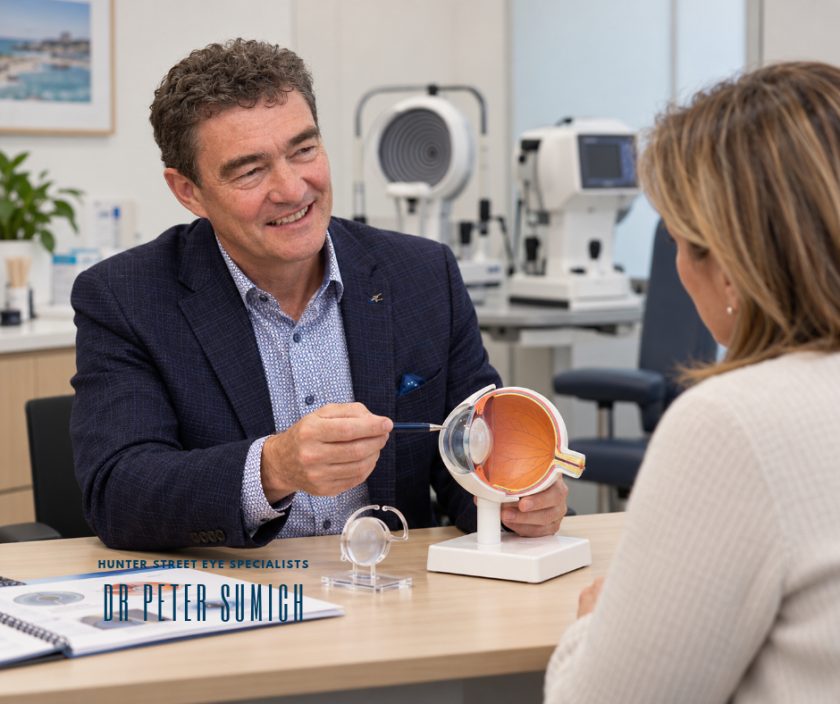
The natural crystalline lens is removed and replaced with an artificial intraocular lens, or IOL.
You may also see broadly similar procedures described as PRELEX (Presbyopic Lens Exchange), Refractive Lens Replacement (RLR), Custom Lens Replacement (CLR), Lens Replacement Surgery, Refractive Lensectomy, Clear Lens Extraction or Clear Lens Exchange (CLE).
The terminology varies, but the basic principle is similar: the natural lens is replaced primarily for refractive reasons rather than because a visually significant cataract is necessarily present.
The operation is similar in principle to cataract surgery.
That also means RLE is intraocular surgery, which is an important difference from corneal laser treatment.
Age changes the discussion
There is no particular birthday at which laser treatment stops being appropriate and RLE becomes the correct answer.
But the natural lens becomes more relevant with age.
During the 40s, most people begin to notice presbyopia, the progressive loss of the eye’s ability to focus at near.
LASIK, SMILE and PRK can alter the eye’s refractive power, but they do not restore the accommodation of a young natural lens.
This means a patient may have excellent distance correction after laser treatment and still require reading glasses as presbyopia progresses.
For some people, particularly when presbyopia is already an important part of the visual problem, a lens-based discussion becomes more relevant.
Prescription can influence the options
The type and size of the prescription matter.
Significant long-sightedness
Patients with significant hyperopia, or long-sightedness, may have a different set of considerations from patients with modest myopia.
A larger hyperopic prescription can be associated with particular ocular dimensions, and the natural lens may also play an increasingly important role as presbyopia develops.
For selected patients, this can make lens-based correction worth discussing.
High short-sightedness
High myopia raises a different set of issues.
A large laser correction may require substantial corneal treatment, but high myopia can also be associated with retinal characteristics that are relevant when considering intraocular surgery.
Changing from a corneal procedure to RLE therefore does not simply remove risk. It changes the type of risk being considered.
The prescription is not just a number. It can tell us something about the architecture of the eye.
Corneal suitability still matters
Sometimes the reason for considering an alternative to laser surgery is the cornea itself.
Corneal thickness, shape, tomography, previous surgery, irregular astigmatism or other findings may make LASIK, SMILE or PRK inappropriate.
That does not automatically mean RLE is the answer.
The rest of the eye still needs to be assessed.
A refractive treatment decision should not become:
“The cornea cannot be treated, therefore replace the lens.”
It should become:
“If corneal treatment is not appropriate, do the alternatives make sense for this eye and this patient?”
That is a different question.
What does the patient want from their vision?
Visual priorities matter just as much as measurements.
One patient may mainly want good unaided distance vision for driving. Another may be most frustrated by reading glasses. Someone working all day at a computer has different intermediate-vision requirements again.
Occupation and lifestyle can therefore influence the discussion.
A professional driver who spends hours in low-light conditions may place particularly high value on night-time visual quality. Someone whose work involves prolonged close or intermediate tasks may prioritise a broader range of focus.
There is no benefit in achieving a technically successful refractive result that does not suit how the patient actually uses their eyes.
Lens choice introduces another set of decisions
If RLE is being considered, the discussion moves from whether to treat the natural lens to what should replace it.
Monofocal, EDOF, multifocal and trifocal lens designs provide different ranges of focus and involve different optical characteristics.
Toric correction may also be incorporated when corneal astigmatism needs to be addressed.
No intraocular lens recreates the natural accommodation of a young eye.
And no lens strategy can guarantee complete freedom from glasses for every task or at every distance.
This is why reducing dependence on glasses should not be confused with guaranteeing spectacle independence.
Why wouldn’t everyone with presbyopia choose RLE?
Because replacing the natural lens is an operation inside the eye.
Potential complications of intraocular surgery need to be considered alongside any refractive benefit.
The individual risk profile varies according to factors such as eye anatomy, prescription, retinal health and other ocular conditions.
For someone functioning well with glasses and a relatively clear natural lens, the expected benefit of RLE may not justify surgery.
For another patient with a different prescription, more advanced presbyopia or early lens changes, the balance may look quite different.
Suitability is not the same as necessity.
What if early cataract is already developing?
This can materially change the discussion.
If the natural lens is beginning to develop cataract, performing corneal laser surgery may correct the prescription while leaving a lens that is likely to continue changing.
That does not mean everyone with early lens changes should immediately have lens surgery.
But the condition of the natural lens should be considered when deciding whether a corneal or lens-based procedure makes more sense in the longer term.
Sometimes the most useful treatment plan is the one that avoids solving today’s refractive problem in a way that creates another decision soon afterwards.
Sometimes neither procedure is the right answer
Refractive surgery is elective.
There is no obligation to choose LASIK, SMILE, PRK or RLE simply because the eye is technically treatable.
Glasses and contact lenses remain effective options.
Sometimes the sensible recommendation is to continue with them and reassess later.
That can be particularly relevant when a patient is approaching a period of visual change but has not yet reached a point where the benefit of surgery clearly outweighs the disadvantages.
The purpose of the assessment is not to find a procedure.
It is to decide whether there is a procedure that makes sense.
Frequently Asked Questions
Is RLE better than LASIK?
No. They treat different parts of the eye and have different benefits, limitations and risks. LASIK changes the cornea, while RLE removes and replaces the natural lens. Which options may be appropriate depends on the individual eye and patient.
Am I too old for LASIK after 50?
Not necessarily. Age alone does not determine suitability. Corneal health, prescription, tear film, natural-lens changes, presbyopia and the patient’s visual requirements all need to be considered.
Does RLE fix presbyopia?
RLE removes the natural lens responsible for the remaining accommodation and replaces it with an IOL. Certain IOL strategies can provide useful vision across more than one distance, but they do not restore the natural accommodation of a young eye.
Can I have RLE if I am not suitable for LASIK?
Possibly, but being unsuitable for corneal laser surgery does not automatically make someone suitable for RLE. A separate assessment of the whole eye and the risks of intraocular surgery is required.
Can I get cataracts after RLE?
No cataract can subsequently develop in the removed natural lens. The capsule supporting the IOL can become cloudy later, however. This is posterior capsule opacification and is different from a cataract.
Will RLE mean I never need glasses again?
Not necessarily. The degree of spectacle independence depends on the IOL strategy, refractive result and the patient’s individual eye. Glasses may still be needed for some tasks.
About the Specialist
Dr Peter Sumich is an ophthalmologist with a clinical focus on cataract surgery, laser vision correction and refractive lens exchange.
His approach to refractive treatment planning considers corneal and lens measurements, eye health, prescription, age and the patient’s individual visual requirements when comparing available options.
Related Articles
Refractive Lens Exchange: What Should Be Considered Before RLE?
A closer look at eye health, prescription, lifestyle and expectations before lens-based refractive surgery.
Laser Eye Surgery in Your 40s: Why Reading Vision Changes the Discussion
Why presbyopia becomes an important part of refractive treatment planning.
Presbyopia: Why Reading Vision Changes After 40
How ageing of the natural lens changes near focusing and the options available to manage it.
LASIK, SMILE or PRK: Why the Right Procedure Depends on Your Eyes
Why the choice of laser procedure depends on the cornea, prescription and other clinical findings.
If you are considering refractive surgery, a comprehensive eye and refractive assessment can help determine whether corneal laser treatment, lens-based treatment or continued use of glasses or contact lenses may be appropriate for your individual circumstances.
Disclaimer
This article provides general educational information only and does not constitute individual medical advice, diagnosis or treatment. Suitability for laser vision correction or refractive lens exchange, expected outcomes, potential benefits, limitations, alternatives and risks depend on individual circumstances and require appropriate clinical assessment.