
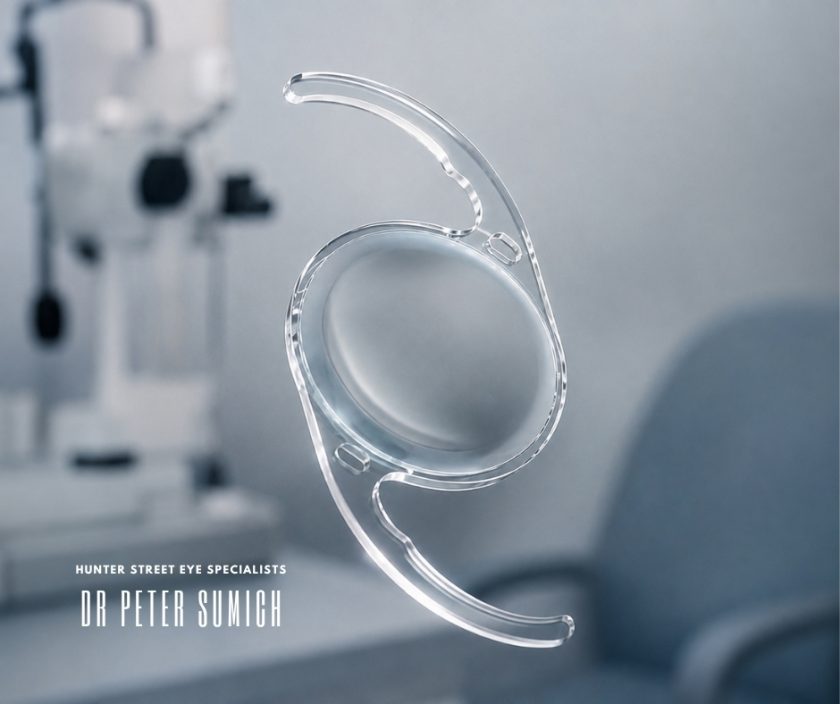
How I Think Through a Lens Choice Before Cataract Surgery
Choosing the lens is part of the surgery
One of the decisions we make before cataract surgery is which intraocular lens to put in the eye.
People sometimes assume this is mainly a matter of taking measurements, entering them into a formula and choosing the lens that produces the right number.
The measurements are important. They do not make the decision.
Modern biometry gives us very detailed information about the length of the eye, the curvature of the cornea and other anatomical features. These measurements help calculate the power of the intraocular lens. Corneal topography and other testing can provide further information where needed, particularly when there is astigmatism, an irregular cornea or previous laser eye surgery.
But there are really two questions.
What lens power should go into the eye?
And:
What are we trying to achieve with it?
They are not the same question.
I start with the patient’s eyes
Before discussing what someone would like to see without glasses, I want to know what their eyes are capable of delivering.
The cornea matters. The macula matters. The optic nerve matters. The tear film matters. Astigmatism matters.
Previous eye surgery can matter considerably.
For example, calculating intraocular lens power after previous corneal laser surgery can be less predictable because the relationship between the front and back surfaces of the cornea has been altered. This may require different measurements and calculation methods.
A lens that makes sense in one eye may therefore be a poor choice in another.
The lens has to suit the eye before it suits the lifestyle.
Then I want to know how the patient actually uses their vision
This is the part that cannot be obtained from a machine.
I want to know what a patient does during an ordinary day.
Do they drive frequently at night? Spend hours at a computer? Read extensively? Play golf? Sew? Work at several different distances? Are they quite comfortable wearing reading glasses, or is reducing their dependence on glasses particularly important to them?
I also want to know what they are accustomed to.
Someone who has successfully used monovision with contact lenses for years is different from someone whose two eyes have always worked at approximately the same distance. Existing visual habits can influence the discussion about what we aim for after surgery.
There is little point achieving an excellent technical result that does not suit the way somebody uses their eyes.
Lens choice involves trade-offs
There is no single intraocular lens that is right for everyone. Different lens designs provide different ranges of focus and involve different compromises. The aim is not to choose the lens with the most features. It is to choose the lens that makes sense for the eye and for what the patient wants to do with their vision.
Monofocal lenses
Monofocal lenses provide one principal point of focus, usually selected for distance, although an eye can instead be targeted for intermediate or near vision. They are optically straightforward, but glasses are usually required for tasks outside the chosen focal range. Monovision, where the two eyes are targeted differently, is another option for selected patients.
Extended depth of focus (EDOF) lenses
EDOF lenses are designed to extend the range of useful vision rather than create several distinct focal points. They generally aim to provide good distance and intermediate vision, with some additional functional near vision depending on the lens and the individual eye. Reading glasses may still be required for fine or prolonged near work.
Multifocal lenses
Multifocal lenses divide light between more than one focal point to provide vision across a broader range, including distance, intermediate and near. They can reduce dependence on glasses, but the trade-off can include halos, glare, changes in contrast or other optical effects. They do not suit every eye or every patient.
Toric lenses
Toric refers to astigmatism correction rather than a particular range of focus. A toric design can be incorporated into a monofocal lens and into some extended-range or multifocal lenses. Whether it is useful depends on the amount and type of corneal astigmatism and the measurements of the eye.
Accommodating lenses
Accommodating IOLs aim to reproduce some of the focusing change of the natural young lens by altering their position, shape or optical power. It is an attractive concept, but reliably recreating natural accommodation remains difficult and technologies in this area continue to develop.
These labels are useful, but they are only the start of the discussion. Every lens involves a balance between range of vision, quality of vision and dependence on glasses.
What I am trying to avoid
I do not like choosing a lens because it is new, because it has an impressive specification sheet, or simply because a patient says, “I don’t want glasses.”
Wanting less dependence on glasses is perfectly reasonable. But we still need to establish whether that goal is realistic and what compromises might come with pursuing it.
No intraocular lens recreates a 25-year-old natural lens.
And no calculation guarantees an exact refractive result.
Even with careful measurement and modern formulae, biological variation means the final focus can differ from the predicted result. Patients may still need glasses for some activities, and occasionally further treatment may be considered.
That uncertainty needs to be part of the discussion before surgery, not discovered afterwards.
The decision
Good lens selection brings three things together:
the measurements, the health of the eye, and the patient.
Technology has made the measurements remarkably sophisticated. It has also given us more lens options than we had in the past.
Both are useful.
But more options do not remove the need for judgement. They make judgement more important.
That is how I think about lens choice.
FAQ
Is there one best lens for cataract surgery?
No. Different intraocular lenses have different optical characteristics, advantages and limitations. The appropriate choice depends on the health and measurements of the eye, the desired visual target and what compromises the patient is comfortable accepting.
Can I choose never to wear glasses after cataract surgery?
Some lens strategies can reduce dependence on glasses, but complete freedom from glasses cannot be guaranteed. The likely outcome depends on the lens selected, the individual eye and the accuracy with which the intended refractive target is achieved. Spectacles may still be required for some tasks.
What if I have previously had LASIK or another laser vision correction procedure?
Previous corneal refractive surgery does not necessarily prevent cataract surgery, but intraocular lens calculations can be more difficult to predict. Additional measurements and calculation methods may be required, and this should be discussed as part of the preoperative assessment.
About the Specialist
Dr Peter Sumich is an ophthalmologist with a clinical focus on cataract surgery, laser vision correction and refractive lens exchange. His approach to treatment planning combines ocular measurements, eye health, visual requirements and the individual patient’s priorities when considering appropriate options.
Related Articles
- What patients should know about cataract surgery
- Types of intraocular lenses: monofocal, EDOF, multifocal and toric lenses
- Why previous laser eye surgery changes cataract lens calculations
Contact
For further information about cataract assessment or lens options, contact Dr Peter Sumich’s rooms online here or ring 02 9635 0663