
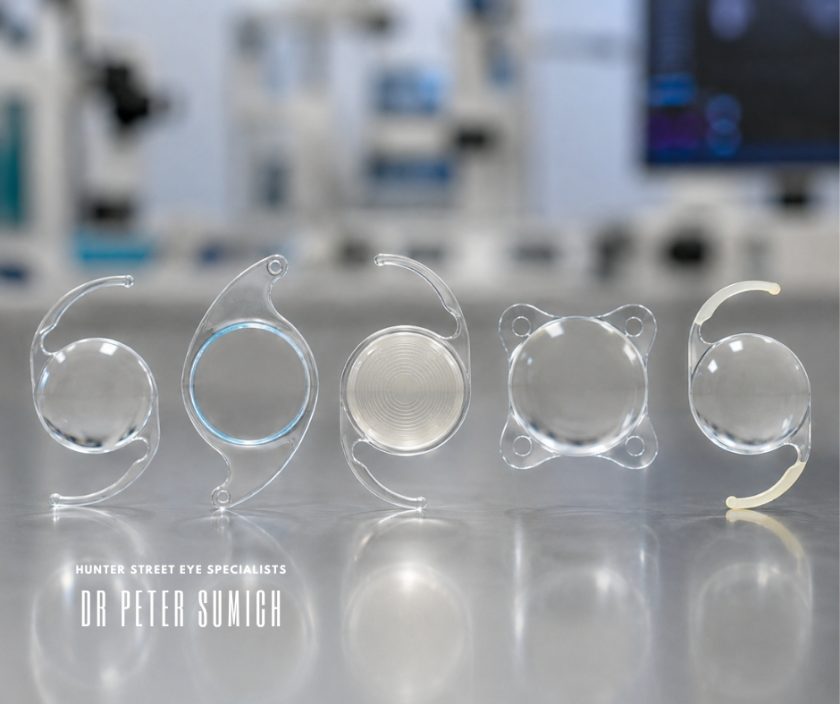
Types of Intraocular Lenses (IOLs)
Cataract surgery removes the eye’s cloudy natural lens and replaces it with a clear artificial lens called an intraocular lens, or IOL.
There are several types of IOLs. The main difference between them is the range of vision they are designed to provide. Some lenses can also incorporate correction for astigmatism.
Understanding these differences makes the discussion about lens choice much easier.
Monofocal IOLs
Monofocal IOLs provide one principal point of focus, usually for distance, although an eye can instead be targeted for intermediate or near vision.
What they can offer
They provide a relatively simple optical system and are generally associated with fewer optical effects such as halos than multifocal lenses.
They can also be used in a monovision strategy, where the two eyes are targeted differently.
What to consider
A monofocal lens does not provide clear vision at every distance. If both eyes are targeted for distance, reading glasses will usually still be required.
Monovision can work well for selected patients but does not suit everyone.
Multifocal IOLs
Multifocal IOLs are designed to provide useful vision at more than one distance by dividing incoming light between different focal points.
Different multifocal designs exist. Some are designed to provide two principal focal ranges, while others are designed to provide three.
What they can offer
Multifocal lenses can reduce dependence on glasses across a wider range of activities than a monofocal lens.
What to consider
There is a trade-off.
Because light is distributed between different focal points, some patients notice halos, glare or other visual effects, particularly around lights at night. Contrast and the perceived quality or sharpness of vision may also differ from that achieved with a monofocal lens.
They are not appropriate for every eye or every patient.
Trifocal IOLs
Trifocal IOLs are a type of multifocal lens designed to provide three principal ranges of focus: distance, intermediate and near.
The intermediate range is particularly useful for tasks such as computer work, looking at a car dashboard or preparing food, while the near focus is intended to assist with activities such as reading.
What they can offer
Trifocal lenses can reduce dependence on glasses across a broad range of everyday distances.
For appropriately selected patients, they may provide useful distance, intermediate and near vision without deliberately targeting the two eyes differently.
What to consider
Providing several focal points requires light to be distributed between those different ranges.
As with other multifocal designs, some patients may notice halos, glare or other optical effects, particularly around lights at night. Contrast and the subjective quality of vision may also differ from a monofocal lens.
A trifocal lens is therefore not automatically a better lens simply because it provides more focal points. The eye needs to be suitable for the optical design, and the potential advantages need to be weighed against the possible compromises.
Extended Depth of Focus (EDOF) IOLs
EDOF lenses are designed to extend the range over which useful vision is available rather than creating several distinct focal points.
They generally aim to provide good distance and intermediate vision, with some additional functional near vision depending on the lens and the individual patient.
What they can offer
Intermediate vision is useful for computers, dashboards, cooking and many everyday activities.
Some EDOF designs may also produce fewer halos than some multifocal lenses.
What to consider
EDOF does not mean complete spectacle independence.
Reading glasses may still be required for small print or prolonged close work.
Toric IOLs
Toric lenses are different because toric refers to astigmatism correction rather than the range of focus provided by the lens.
A toric IOL incorporates different powers to help correct corneal astigmatism and needs to be positioned at a specific orientation within the eye.
What they can offer
A toric IOL can reduce pre-existing corneal astigmatism and may reduce dependence on glasses for the distance at which the lens is targeted.
What to consider
Toric is not a separate focusing category in the same way as monofocal, multifocal or EDOF.
Toric technology can be incorporated into different IOL designs, including monofocal, EDOF and some multifocal or trifocal lenses.
What about accommodating IOLs?
The natural lens of a younger eye changes its focusing power as we shift from distance to near. This is called accommodation.
An accommodating IOL aims to reproduce some of this ability by moving, changing shape or otherwise altering its optical power.
It is an attractive concept, but reliably reproducing the accommodation of the natural young lens remains difficult. New technologies continue to be investigated.
How the different lens types fit together
Monofocal, multifocal and EDOF mainly describe how an IOL is designed to provide focus.
Trifocal lenses sit within the broader multifocal category and are specifically designed to provide distance, intermediate and near focal ranges.
Toric describes correction of astigmatism rather than range of focus.
A toric lens may therefore also be monofocal, EDOF or multifocal, including some trifocal designs.
The next question is which combination makes sense for an individual patient. For that clinical reasoning, see How I Think Through a Lens Choice Before Cataract Surgery.
Frequently Asked Questions
Which intraocular lens is best for cataract surgery?
There is no single lens that is right for everyone. Different IOLs provide different ranges of focus and involve different optical compromises.
Will I still need glasses after cataract surgery?
Possibly. The likelihood depends on the type of IOL, the visual target and the final refractive result.
No lens strategy can guarantee complete freedom from glasses for every task or at every distance.
Are multifocal lenses better than monofocal lenses?
Neither is universally better.
Multifocal lenses can provide a broader range of vision but are more likely to produce optical effects such as halos and glare.
What is the difference between a multifocal and trifocal IOL?
Trifocal lenses are a type of multifocal IOL.
The term trifocal refers specifically to a design intended to provide three principal ranges of focus: distance, intermediate and near.
Is an EDOF lens the same as a multifocal lens?
No.
EDOF lenses are designed to extend the range of useful focus rather than creating several distinct focal points.
Is a toric lens a different type of lens?
Toric describes astigmatism correction rather than the focusing range of the lens.
A toric design can be incorporated into several different types of IOL.
About the Specialist
Dr Peter Sumich is an ophthalmologist with a clinical focus on cataract surgery, laser vision correction and refractive lens exchange. His approach to treatment planning combines ocular measurements, eye health, visual requirements and the individual patient’s priorities when considering appropriate options.
Related Articles
How I Think Through a Lens Choice Before Cataract Surgery
How eye health, measurements and visual priorities are brought together when considering an intraocular lens.
LASIK, SMILE or PRK: Why the Right Procedure Depends on Your Eyes
If you are considering cataract surgery, a full eye assessment can help determine which lens options may be appropriate for your individual eyes and visual requirements.
Disclaimer
This article provides general educational information only and does not constitute individual medical advice. Treatment suitability, risks, benefits, alternatives and expected outcomes depend on individual circumstances and require appropriate clinical assessment.