Why I Sometimes Repeat Eye Measurements Before Cataract Surgery
One of the questions patients occasionally ask before cataract surgery is why we need to repeat a measurement when it has already been taken.
It is a reasonable question.
Modern ophthalmic instruments provide detailed measurements of the eye, often within seconds. But obtaining a measurement and deciding whether that measurement is reliable are two different things.
When planning cataract surgery, I am not simply looking for a number. I want measurements that are consistent and make sense when considered alongside the rest of the examination.
Sometimes that means measuring the eye again.
What are we measuring before cataract surgery?
During cataract surgery, the cloudy natural lens is removed and replaced with an artificial intraocular lens, or IOL.
The power of that replacement lens needs to be calculated before surgery.
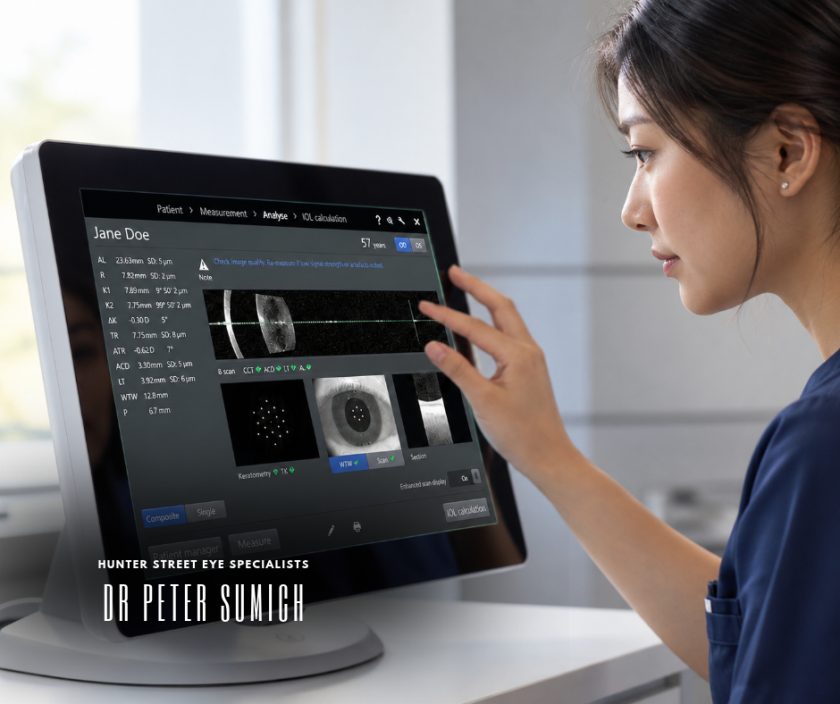
One of the main investigations is called optical biometry. It measures important dimensions of the eye, including its length and the curvature of the cornea.
Other investigations, such as corneal topography or tomography, may be used to assess the shape of the cornea in more detail.
These measurements are used in mathematical formulae to help select an appropriate IOL power.
But the calculations are only as useful as the information entered into them.
Why might measurements vary?
The tear film can change the readings
The cornea is the clear front surface of the eye. Covering it is a thin layer of tears that helps maintain a smooth optical surface.
If the tear film is unstable, measurements of corneal curvature can vary.
This can happen in patients with dry eye disease, sometimes even when they have few noticeable symptoms.
When I see inconsistent corneal readings, the condition of the ocular surface is one of the things to consider.
Treating a significant surface problem and repeating the measurements once it has improved may provide more reliable information for lens planning.
Contact lenses can influence corneal shape
Contact lenses can temporarily alter the shape of the cornea, particularly with certain rigid lens designs or prolonged wear.
For this reason, patients may be asked to leave their contact lenses out for a period before preoperative measurements.
The required time varies according to the lens type, history of wear and stability of the corneal measurements.
The important point is that the cornea should be sufficiently stable before final lens calculations are made.
Previous laser eye surgery can make calculations more complex
Patients who have previously undergone LASIK, PRK or other corneal refractive procedures can still undergo cataract surgery when clinically appropriate.
However, previous treatment changes the cornea’s optical characteristics.
Standard IOL calculations may therefore be less predictable, and additional measurements or specialised calculation methods may be required.
A similar need for individualised assessment can arise in eyes with irregular corneas or previous corneal surgery.
What am I looking for when I compare measurements?
I want to know whether the results are repeatable and whether they agree with the other clinical findings.
For example, if different instruments suggest substantially different amounts or directions of corneal astigmatism, I would want to understand why before finalising the lens plan.
Sometimes the explanation is straightforward. At other times, the eye surface needs treatment, additional testing is useful, or the measurements need to be repeated on another day.
This is particularly relevant when considering a toric IOL, where the amount and axis of corneal astigmatism influence lens selection.
It can also matter when considering multifocal or extended-depth-of-focus lenses, because the quality of the ocular surface and other aspects of eye health can influence the visual result.
Does repeating measurements mean something is wrong?
Not necessarily.
There is a difference between an abnormal finding and a measurement that needs confirmation.
Sometimes the first set of measurements is entirely adequate. Sometimes additional information helps clarify the picture.
If the corneal surface is not sufficiently stable, it may be more sensible to address that problem before proceeding with the final calculations.
The timing depends on the individual eye and the clinical circumstances.
Can accurate measurements guarantee the result?
No.
Even with consistent measurements and appropriate calculation methods, the final refractive outcome after cataract surgery cannot be predicted with absolute certainty.
The position of the implanted lens, healing and individual anatomical characteristics can all influence the result.
Some patients will still require glasses for particular activities. A residual prescription may remain, and occasionally further treatment may be considered.
Cataract surgery also carries risks, including infection, inflammation, changes in eye pressure and retinal complications. These need to be discussed separately from the accuracy of lens calculations.
Good measurements help inform the surgical plan. They do not remove every uncertainty associated with surgery.
What I want patients to understand
If I recommend repeating a measurement, it is not necessarily because the original test was performed incorrectly.
It may simply mean that I want to resolve an inconsistency before relying on the result.
Choosing an intraocular lens involves more than selecting a number from a printout. The measurements, the health of the eye and the patient’s visual requirements all need to be considered together.
Sometimes the useful decision is to take another measurement before making the next one.
Frequently Asked Questions
Why do I need eye measurements before cataract surgery?
Measurements such as eye length and corneal curvature are used to calculate the power of the artificial lens implanted during cataract surgery. They help establish the intended postoperative focus.
Does dry eye affect cataract lens calculations?
It can. An unstable tear film may affect corneal curvature readings and therefore the reliability of IOL calculations. Significant ocular surface problems may need treatment before measurements are finalised.
How long should I stop wearing contact lenses before cataract measurements?
This depends on the type of contact lens and the stability of your cornea. Soft and rigid lenses can require different periods without wear. Follow the instructions provided by your treating clinic rather than assuming one interval applies to everyone.
Are repeat measurements needed for every patient?
No. Many patients have consistent measurements at their initial assessment. Repeat testing is considered when readings are unreliable, inconsistent or require further confirmation.
Can I still need glasses after cataract surgery?
Yes. Even with appropriate measurements and lens selection, glasses may still be required for some activities or distances. The likelihood depends on the IOL selected, the intended visual target and the individual result.
About the Specialist
Dr Peter Sumich is an ophthalmologist with a clinical focus on cataract surgery, laser vision correction and refractive lens exchange.
His approach to treatment planning considers ocular measurements, eye health, the patient’s visual requirements and the limitations of available treatment options when discussing appropriate care.
Related Articles
How I Think Through a Lens Choice Before Cataract Surgery – Why lens selection involves more than the measurements alone.
Types of Intraocular Lenses (IOLs) – Understanding monofocal, toric, EDOF and multifocal lens designs.
Refractive Lens Exchange: What Should Be Considered Before RLE? – How eye health, measurements and visual requirements influence lens-based refractive surgery.
For further information about cataract assessment or intraocular lens planning, contact Dr Peter Sumich‘s rooms at Hunter Street Eye Specialists on 02 9635 0663.
Disclaimer
This article provides general educational information only and does not constitute individual medical advice, diagnosis or treatment. Suitability for cataract surgery, intraocular lens selection, expected outcomes, limitations, alternatives and risks depend on individual circumstances and require appropriate clinical assessment.