
Questions I Wish Every Cataract Patient Would Ask
Most cataract consultations include the obvious questions.
Will the operation hurt? How long will it take? When can I drive?
They are sensible questions. But there are a few others I think are more useful because they get to the heart of whether surgery is needed, what we are trying to achieve and what the eye is realistically capable of afterwards.
These are the questions I would encourage patients to ask.
Do I actually need cataract surgery now?
A cataract does not need to be removed simply because it is there.
The important question is whether it is affecting vision enough to interfere with the things you need or want to do.
For one patient that may mean difficulty driving at night because of glare. For another it may be reading, recognising faces, playing golf or working comfortably at a computer.
If the cataract is mild and the patient is functioning well, there may be little reason to rush.
We operate on the patient, not the photograph of the cataract.
Is the cataract the only reason my vision is reduced?
This is one of the most important questions.
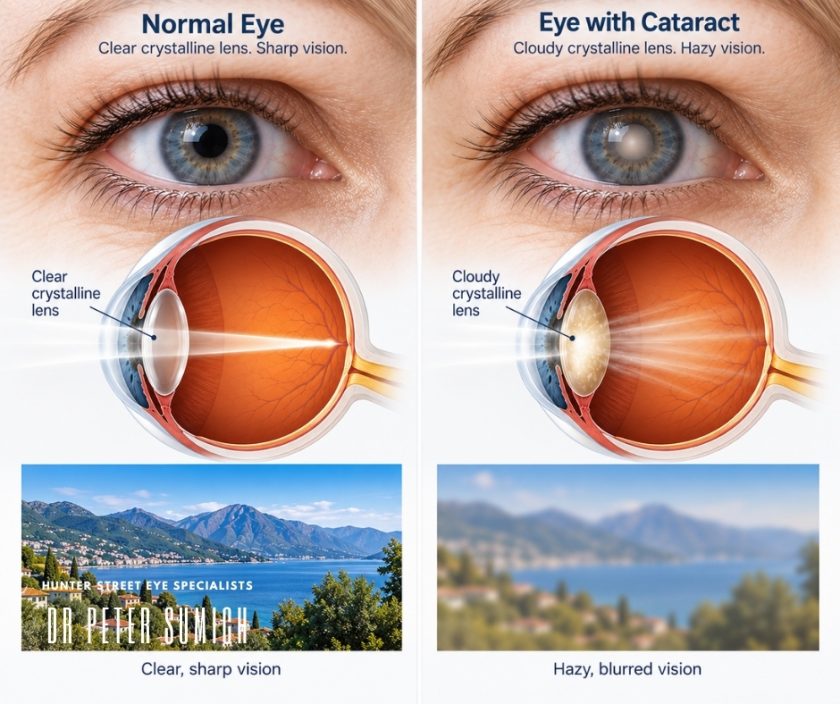
Removing a cataract can address the cloudy natural lens. It cannot correct vision loss caused by the macula, optic nerve, cornea or other parts of the eye.
That is why the pre-operative assessment matters.
If there is macular degeneration, glaucoma, corneal disease or another condition affecting vision, I want the patient to understand how that may influence the expected result before surgery.
Sometimes cataract surgery can still be worthwhile. The expectation simply needs to be realistic.
What are we aiming for with my vision?
Patients sometimes think cataract surgery simply restores normal vision.
There is another decision involved.
When the cataract is removed, it is replaced with an intraocular lens. We therefore have an opportunity to choose the approximate refractive target of the eye.
Do we want both eyes principally focused for distance? Is some degree of monovision appropriate? Is reducing dependence on reading glasses particularly important? Would the optical characteristics of a broader-range lens suit this eye and this patient?
The answer depends on much more than the cataract itself.
The patient’s existing prescription, eye health, occupation, lifestyle and visual priorities all matter.
Will I still need glasses?
This deserves a straightforward answer.
Possibly.
The likelihood depends on the lens strategy, the visual target, astigmatism and the final refractive result.
A monofocal lens targeted for distance will generally mean reading glasses are still needed. Other lens strategies can extend the useful range of vision, but they introduce different optical characteristics and potential compromises.
No lens strategy can guarantee complete freedom from glasses for every task or at every distance.
The useful discussion is not simply, “Will I need glasses?”
It is:
“What am I most likely to need glasses for?”
What compromises come with the lens I am considering?
Every intraocular lens has strengths and limitations.
A lens designed to provide a broader range of vision may reduce dependence on glasses, but some designs can also produce halos, glare or differences in contrast and visual quality.
A monofocal lens has a simpler optical design, but it provides a more limited range of focus.
Toric correction can address corneal astigmatism, but toric describes astigmatism correction rather than the range of focus of the lens.
There is no point discussing only what a lens can provide.
Patients also need to understand what they may be giving up to get it.
What are the risks in my particular eye?
All surgery carries risk, but risk is not identical from one eye to another.
The anatomy of the eye, prescription, cornea, retina, optic nerve, previous surgery and other medical factors can change the discussion.
A highly myopic eye, for example, may raise different considerations from a small hyperopic eye. Previous laser vision correction creates another set of considerations when calculating intraocular lens power.
I prefer patients to ask about the risks that apply to their eye, rather than relying only on a generic list.
How precise can the result be?
Modern biometry and lens calculation formulae are very good.
They are not perfect.
We measure the eye before surgery and calculate the IOL power that is most likely to produce the intended refractive result. But biological eyes vary, healing varies and the final focus can differ from the prediction.
A small residual prescription after uncomplicated surgery does not necessarily mean anything has gone wrong.
The measurements matter. So does biological variation.
What will the first few weeks actually be like?
Patients understandably focus on the operation itself. The recovery period is also worth discussing.
Vision may improve quickly, but it can fluctuate initially. The cornea, tear film, inflammation and pupil size can all affect early vision.
Drops are generally required for a period after surgery, and there are temporary restrictions around activities while the eye heals.
I also want patients to know which symptoms should prompt an earlier review rather than simply waiting for the next scheduled appointment.
Knowing what is expected makes it much easier to recognise what is not.
What happens to the other eye?
Cataracts often develop in both eyes, although not necessarily at exactly the same rate.
The visual target chosen for the first eye can influence planning for the second.
Sometimes the result of the first operation gives us useful information before proceeding with the fellow eye. It may confirm that the original plan makes sense or occasionally lead us to adjust the target.
The two eyes are part of one visual system. It makes sense to plan them that way.
The question underneath all the others
There is one broader question I think patients should feel comfortable asking:
“Why are you recommending this for me?”
A good treatment plan should be explainable.
The answer should make sense in terms of the health of the eye, the patient’s visual problem, the available alternatives and what the patient is hoping to achieve.
Technology is useful. Measurements are useful. Lens options are useful.
But they are tools.
The decision still needs to make sense for the person sitting in front of us.
Frequently Asked Questions
How do I know when my cataract is ready for surgery?
There is no single level of cataract that automatically means surgery is required. Surgery is generally considered when the cataract is affecting vision or daily activities enough that the expected benefit of surgery justifies proceeding.
Can cataract surgery improve all causes of poor vision?
No. Cataract surgery removes the cloudy natural lens. Vision can still be limited by conditions involving the cornea, retina, macula or optic nerve.
Will I definitely need glasses after cataract surgery?
Not necessarily, but glasses may still be required for some tasks. The likelihood depends on the intraocular lens, refractive target, astigmatism and final result.
Is the most expensive intraocular lens the best one?
No. Cost does not determine suitability. Different lenses have different optical characteristics, and the appropriate choice depends on the individual eye and the patient’s visual requirements.
Can the lens power calculation be wrong?
IOL calculations are estimates based on detailed measurements of the eye. Modern methods are accurate, but the final refractive result cannot be predicted with absolute precision. A residual prescription can occur despite appropriate measurements and uncomplicated surgery.
About the Specialist
Dr Peter Sumich is an ophthalmologist with a clinical focus on cataract surgery, laser vision correction and refractive lens exchange. His approach to cataract treatment planning considers the health and measurements of the eye alongside the patient’s visual requirements and individual circumstances.
Related Articles
How I Think Through a Lens Choice Before Cataract Surgery
How measurements, eye health and patient priorities influence intraocular lens selection.
Types of Intraocular Lenses (IOLs)
A practical explanation of monofocal, multifocal, trifocal, EDOF and toric intraocular lenses.
What Happens to Your Vision After Cataract Surgery?
Why vision can fluctuate initially and what influences the final visual result.
If you are considering cataract surgery, a comprehensive eye assessment can help establish whether surgery is appropriate, what may be limiting your vision and which treatment options are relevant to your individual eyes.
Disclaimer
This article provides general educational information only and does not constitute individual medical advice, diagnosis or treatment. Suitability for cataract surgery, intraocular lens selection, potential benefits, limitations, alternatives and risks depend on individual circumstances and require appropriate clinical assessment.