Does Cataract Surgery Correct Astigmatism?
When patients consider cataract surgery, they often ask whether they will still need glasses afterwards.
The answer depends on several factors, including the health of the eye, the intraocular lens selected and whether astigmatism is present.
Cataract surgery removes the cloudy natural lens and replaces it with an artificial intraocular lens (IOL). This provides an opportunity to address certain refractive errors, but it does not automatically correct all of them.
Astigmatism is one reason some patients may still experience blurred or distorted vision after otherwise uncomplicated cataract surgery.
What is astigmatism?
Astigmatism occurs when the eye has different focusing powers in different directions.
In an eye with regular corneal astigmatism, the cornea is more curved in one direction than another. Instead of light coming to a single sharp focus, it focuses differently across these directions.
This can cause blurred or distorted vision at both distance and near.
Astigmatism is common and may exist alongside short-sightedness or long-sightedness.
Where does astigmatism come from?
Astigmatism can arise from the cornea, the natural lens or a combination of both.
This distinction becomes important when planning cataract surgery.
Corneal astigmatism
The cornea is the clear window at the front of the eye. Its curvature provides much of the eye’s focusing power.
If the cornea has different curvatures in different directions, it produces corneal astigmatism.
Removing a cataract does not remove the cornea, so this astigmatism generally remains unless it is specifically addressed.
Lenticular astigmatism
The natural lens can also contribute to astigmatism.
When the lens is removed during cataract surgery, its contribution to the eye’s astigmatism is removed as well.
However, any remaining corneal astigmatism may still affect the final vision.
This is why the glasses prescription alone does not tell us exactly how much astigmatism needs to be addressed during cataract surgery.
How can astigmatism be corrected during cataract surgery?
One option is a toric intraocular lens.
A toric IOL has different optical powers in different directions, allowing it to compensate for regular corneal astigmatism.
The lens must be selected according to the measurements of the eye and positioned at the intended orientation.
Unlike an ordinary monofocal IOL, which primarily corrects the eye’s overall focusing power, a toric IOL also incorporates astigmatism correction.
Toric designs are available with different ranges of focus, including monofocal and certain presbyopia-correcting lenses.
Why do corneal measurements matter?
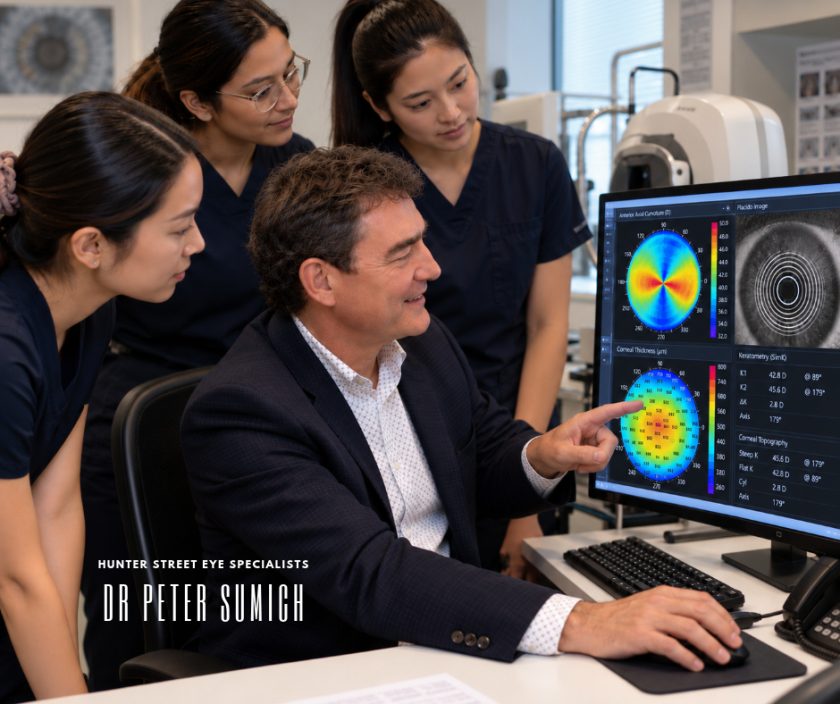
Before cataract surgery, measurements are taken to calculate the appropriate intraocular lens power.
When astigmatism is present, we also need to understand its amount and orientation.
Corneal imaging can provide detailed information about the curvature of the front surface, while additional measurements and calculations help account for the back surface of the cornea.
The tear film also matters. An unstable ocular surface can affect the accuracy and consistency of measurements.
This is why measurements may sometimes need to be repeated before finalising the lens calculation.
Accurate measurements help guide the choice of lens, but they cannot guarantee a particular refractive result.
Does everyone with astigmatism need a toric lens?
No.
The decision depends on the amount and type of astigmatism, the patient’s visual requirements and the overall condition of the eye.
Small amounts of astigmatism may not justify toric correction in every case.
Other approaches, including selected corneal incisions, may be considered in appropriate circumstances.
Irregular astigmatism requires particular attention because it may not be adequately corrected by a conventional toric lens.
The aim is not necessarily to eliminate every measurable refractive error. It is to determine which correction is appropriate for the individual eye and the patient’s visual goals.
Will a toric lens mean I no longer need glasses?
Not necessarily.
A toric IOL is designed to reduce astigmatism, but the final prescription can still differ from the intended target.
A patient receiving a monofocal toric lens targeted for distance will generally still need reading glasses.
There may also be residual astigmatism or another refractive error after surgery.
Toric lenses must remain appropriately aligned to provide their intended correction. Occasionally, rotation or another change in lens position can affect the result.
These considerations are discussed before surgery rather than assuming that a toric lens will eliminate the need for glasses.
Why the final result depends on more than the lens
Cataract surgery provides an opportunity to address both the cloudy natural lens and aspects of the eye’s refractive error.
But the final visual result depends on the entire optical system.
Corneal shape, ocular surface health, lens calculations, IOL position and the condition of the retina and optic nerve can all influence vision.
The useful question is therefore not simply whether cataract surgery can correct astigmatism.
It is how much astigmatism is present, where it comes from and whether correcting it during surgery is appropriate for that particular eye.
That is what a detailed pre-operative assessment helps establish.
Frequently Asked Questions
Does cataract surgery automatically remove astigmatism?
No. Removing the natural lens eliminates its contribution to astigmatism, but corneal astigmatism generally remains unless it is specifically addressed.
What is a toric intraocular lens?
A toric IOL is an artificial lens designed to correct regular corneal astigmatism. It has different optical powers in different directions and must be positioned at the intended orientation inside the eye.
Can I still have astigmatism after cataract surgery?
Yes. Residual astigmatism can remain even when a toric lens is used. The final result depends on several factors, including corneal measurements, lens calculations and IOL alignment.
Is a toric lens suitable for everyone?
No. Suitability depends on the type and amount of astigmatism, corneal characteristics, eye health and visual requirements. Irregular astigmatism may require a different approach.
Will I need glasses after receiving a toric IOL?
Possibly. A toric lens can reduce astigmatism but does not guarantee freedom from glasses. Reading glasses are generally still required with a monofocal toric lens targeted for distance.
About the Specialist
Dr Peter Sumich is an ophthalmologist with a clinical focus on cataract surgery, laser vision correction and refractive lens exchange.
His approach to cataract treatment planning considers ocular measurements, corneal health, the patient’s existing prescription and their individual visual requirements when assessing intraocular lens options.
Related Articles
How I Think Through a Lens Choice Before Cataract Surgery
How eye health, measurements and visual priorities influence intraocular lens selection.
Questions I Wish Every Cataract Patient Would Ask
The questions that help clarify expected vision, lens choice, risks and recovery before cataract surgery.
Why Is My Vision Blurry After Cataract Surgery?
Why corneal swelling, tear-film changes, inflammation and other factors can affect vision during recovery.
For patients considering cataract surgery, a comprehensive eye assessment can help determine whether astigmatism is present and which treatment options may be appropriate.
Disclaimer
This article provides general educational information only and does not constitute individual medical advice, diagnosis or treatment. Suitability for cataract surgery, intraocular lens selection, expected outcomes, potential benefits, limitations, alternatives and risks depend on individual circumstances and require appropriate clinical assessment.