
Refractive Lens Exchange: When Does It Make Sense?
People looking to reduce their dependence on glasses often assume that laser vision correction is the starting point.
For younger patients, procedures that reshape the cornea may indeed be appropriate. But as we get older, another part of the eye increasingly becomes responsible for changes in vision: the natural lens.
Refractive lens exchange also known as Clear lens exchange (CLE), or RLE, addresses the lens rather than the cornea. It can be useful for selected patients, particularly when age-related changes in near focusing have become an important part of the visual problem.
It is also intraocular surgery, so the potential advantages need to be considered alongside its limitations and risks.
What is refractive lens exchange?
RLE involves removing the eye’s natural crystalline lens and replacing it with an artificial intraocular lens, or IOL.
Technically, the procedure has much in common with cataract surgery. The important distinction is why it is being performed.
In cataract surgery, the natural lens has become sufficiently cloudy to affect vision. With RLE, the lens may still be relatively clear, but it is replaced primarily to alter the eye’s focus and reduce dependence on glasses or contact lenses.
Because the natural lens is removed, that eye cannot subsequently develop a cataract.
Why does age matter?
The natural lens of a younger eye can change its focusing power to move between distance and near. This ability is called accommodation.
Accommodation gradually declines with age. The resulting difficulty with near focus is called presbyopia, and it is why most people eventually require reading glasses or another form of near correction.
Corneal laser procedures can alter the eye’s refractive power, but they do not restore the natural lens’s lost ability to accommodate.
For someone whose visual difficulty increasingly involves both their prescription and presbyopia, this distinction can become important when considering treatment options.
How does RLE differ from laser vision correction?
LASIK, SMILE and PRK reshape the cornea. The natural lens remains in the eye.
RLE changes the eye’s focusing system by replacing the natural lens with an IOL.
Neither approach is inherently better. They solve different refractive problems and have different risk profiles.
Age, prescription, corneal measurements, eye health, the condition of the natural lens and the patient’s visual priorities all influence which options are reasonable to consider.
For some patients, continuing with glasses or contact lenses remains the most appropriate choice.
The intraocular lens becomes important
Once the natural lens is removed, the optical characteristics of the replacement IOL influence the range of vision afterwards.
A monofocal IOL provides one principal point of focus. Other lens designs, including extended depth of focus and multifocal IOLs, are intended to provide a broader range of useful vision.
Toric correction may also be incorporated when appropriate for corneal astigmatism.
These lenses do not recreate a young natural eye. Each approach involves a different balance between range of vision, quality of vision and dependence on glasses.
That discussion is an important part of considering RLE.
What should be considered before RLE?
A refractive assessment needs to establish more than your glasses prescription. It should include a full eye health assessment to determine whether RLE is appropriate and to identify any factors that may influence the choice of treatment or expected visual outcome.
The health of the eye
The cornea, retina, macula and optic nerve all contribute to the eventual quality of vision.
Pre-existing eye disease may affect whether RLE is appropriate and may also influence the type of IOL considered.
The prescription
The size and type of your refractive error matter.
A patient with significant hyperopia, for example, presents a different set of considerations from someone with high myopia. A larger prescription can also reflect an eye whose dimensions sit outside the usual range, and that anatomy may influence both the choice of treatment and the risks of intraocular surgery.
The prescription is not just a number. It can tell us something about the eye itself.
The patient’s visual priorities
What the patient wants from their vision matters.
For one person, reducing dependence on reading glasses may be the main priority. Another may place greater value on crisp distance vision, night driving or maintaining good intermediate vision for computer work. Sometimes that comes down to their job or lifestyle. A professional driver, for example, may have very different priorities from someone who spends most of the day at a computer or doing close work.
Some patients are comfortable using glasses for certain tasks if it means fewer optical compromises.
Those priorities help determine whether RLE is worth considering at all, and if it is, which lens strategy makes the most sense. The aim is not simply to reduce glasses use. It is to choose an approach that fits how the patient actually uses their vision.
What to consider
RLE should not be thought of simply as permanent laser eye surgery for older patients.
It is an intraocular operation and carries surgical risks. These can include infection, inflammation, retinal complications, changes in eye pressure and other uncommon but potentially significant complications.
The IOL also remains in the eye permanently unless there is a clinical reason for further surgery.
Visual outcomes cannot be guaranteed. A residual glasses prescription can remain, glasses may still be required for some activities, and some IOL designs can produce optical effects such as halos or glare.
The relevance of these risks and compromises differs considerably between patients.
Frequently Asked Questions
Is refractive lens exchange the same as cataract surgery?
The surgical principles are similar because both involve removing the natural lens and replacing it with an IOL. The main difference is the indication: RLE is performed primarily for refractive reasons rather than because a cataract is impairing vision.
What age is best for refractive lens exchange?
There is no particular age at which RLE automatically becomes appropriate. Age is considered alongside prescription, presbyopia, the condition of the natural lens, eye health and the patient’s visual requirements.
Is RLE better than LASIK?
One is not better than the other, they serve different purposes. LASIK changes the cornea while RLE replaces the natural lens. They are different procedures suited to different circumstances.
Will I need reading glasses after RLE?
Possibly. This depends partly on the IOL and visual targets selected. No lens strategy can guarantee complete freedom from glasses at every distance.
Can I develop cataracts after RLE?
No. Once the natural crystalline lens has been removed, it cannot subsequently develop a cataract. The capsule supporting the IOL can become cloudy later, however. This is called posterior capsule opacification and can usually be treated with a YAG laser procedure in rooms, when appropriate.
About the Specialist
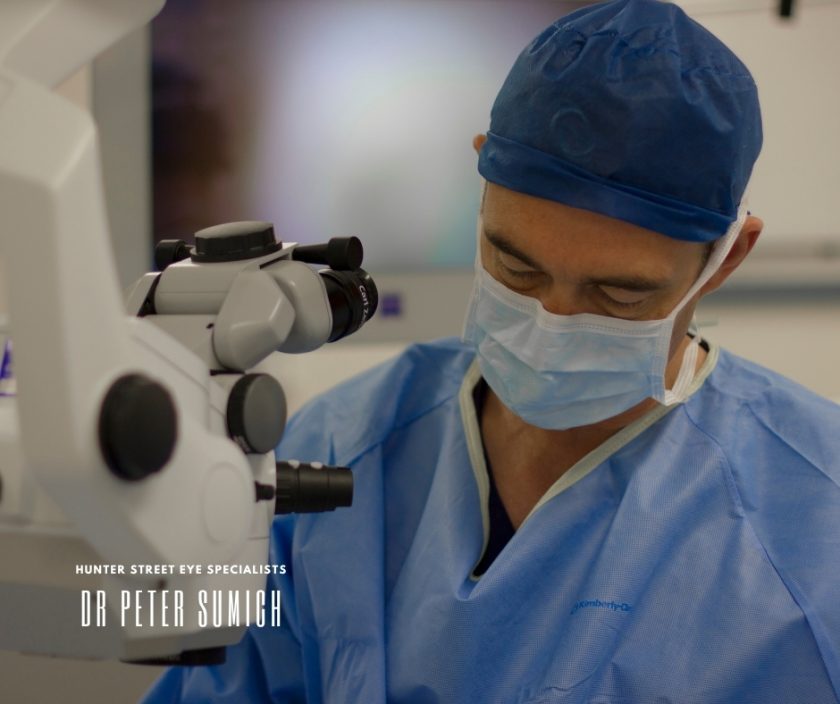
Dr Peter Sumich is an ophthalmologist with a clinical focus on cataract surgery, laser vision correction and refractive lens exchange. His approach to refractive treatment considers the health and measurements of the eye alongside the patient’s age, visual requirements and individual circumstances.
Related Articles
- Types of Intraocular Lenses (IOLs)
- How I Think Through a Lens Choice Before Cataract Surgery
- LASIK, SMILE or PRK: Why the Right Procedure Depends on Your Eyes
A comprehensive eye assessment can determine whether refractive lens exchange, laser vision correction or continued use of glasses or contact lenses may be appropriate for your individual circumstances.
Disclaimer
This article provides general educational information only and does not constitute individual medical advice, diagnosis or treatment. Suitability for refractive lens exchange, potential benefits, limitations, alternatives and risks vary between individuals and require appropriate clinical assessment.